


 Construction
 Transportation
 Manufacturing
 Blog
Blog
 About Us
 Contact Us

 Book a demo
 Free Trial
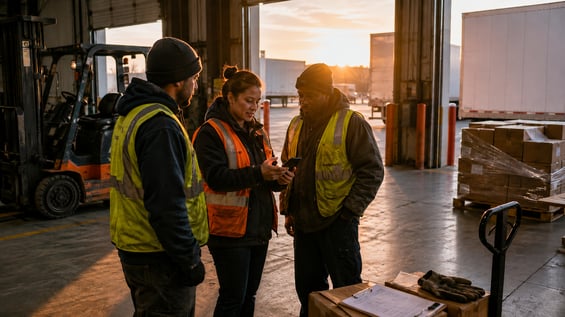

 Deskless workers
No desk. No computer. No email.
That's daily life for millions of workers we call deskless.
The term may sound a little technical. Their reality isn't.
They don't spend the day in front of a screen. They're on job sites, in plants, on the road, in shops, in warehouses, or right in front of customers.
They build. They haul. They repair. They install. They manufacture. They keep operations moving while a good part of the organization works behind a computer.
And yet internal communication tools were built first for the people who have… a desk.
Their desk is the field
One site today. Another tomorrow.
A truck between two calls. A shop. A plant. A highway. Sometimes several workplaces in a single day.
Frontline teams are constantly on the move, but the information they need doesn't always follow them as easily.
A schedule change goes out by text
A procedure sits in a document somewhere
Important news is emailed to employees who rarely open their inbox
Training has to wait until everyone is available in the same place
The problem isn't that frontline workers are hard to reach.
It's that traditional tools were never designed for their reality.
What frontline teams are often missing
When you work behind a computer, several things are almost automatic:
In the field, none of that is a given.
And yet these teams deal with instructions that change fast, new procedures, safety requirements, mandatory training and a mass of information they need to do the work well.
Too often, that information is scattered across several tools, several people and several channels.
The result: the information exists, but it doesn't always reach the people who need it.
And yet they're the ones keeping operations running
Without frontline teams, projects don't move.
Buildings don’t get built.
Goods don’t move.
Equipment doesn’t get repaired.
Production lines don’t run.
These workers also hold field knowledge no dashboard can replace.
They see the problems. They know the shortcuts that work, the processes that slow operations down, and the realities you don't necessarily discover in a meeting room.
Yet that expertise still rarely makes its way back to the rest of the organization.
And when such an important part of the company is hard to reach, the whole organization loses something.
Internal communication has to work without a desk too
Good internal communication shouldn't depend on a computer.
It should give every person access to the information that concerns them, whatever their role or workplace.
That means adapting tools to the reality of frontline teams rather than asking them to adapt to systems built for the office.
Because being far from the office should never mean being far from the company.
That's exactly why BRIX exists
BRIX was built for the people doing the work in the field.
An app that lets organizations connect, train and engage their deskless teams, straight from their phone.
Communications, training and important information can follow workers wherever the job takes them.
No need to be in front of a computer.
No need to watch an inbox all day.
No need to hunt for information in five different places.
The goal is simple: give frontline teams more direct access to what they need to know, and let them stay connected to the organization they're part of.
Because a worker without a desk should never be a worker without a voice
The frontline workforce isn't on the margins of the company.
It is the company.
These are the people who build, haul, manufacture, maintain and keep running a large share of what surrounds us.
Including them in communications, training and company culture shouldn't be an afterthought.
It should be obvious.
Because you can't build a strong culture while leaving part of the team outside.

Comment augmenter l'adoption des applications de formation terrain en 2027
Pourquoi les applications de formation terrain restent-elles sous-utilisées ? Les équipes terrain n'ont pas le luxe d'un bureau, d'une connexion.

Qu'est-ce qui empêche les travailleurs terrain d'utiliser les applications de formation ?
Qu'est-ce qui empêche les travailleurs terrain d'utiliser les applications de formation ? Accès, temps, pertinence : les trois freins qui tiennent.

7 échecs de plateformes terrain dans les entreprises industrielles
7 raisons pour lesquelles les plateformes terrain échouent à grande échelle 80 % de la main-d'œuvre mondiale travaille sur le terrain, souvent sans.


