


 Construction
 Transportation
 Manufacturing
 Blog
Blog
 About Us
 Contact Us

 Book a demo
 Free Trial
.jpg?width=565&height=355&name=image%20(26).jpg)

 Continuous training
Continuous training: a strategic lever for frontline teams
Work is changing fast. New technologies, new methods, new standards, new expectations: companies have to adapt constantly, and so do their teams.
In that context, continuous training is no longer just a perk. It becomes a genuine strategic lever to keep skills current, improve performance and prepare teams for tomorrow's realities.
For companies with a large frontline workforce, though, the challenge is very real:
How do you train teams effectively when they don't all work in the same place, or at the same time?
The limits of traditional training
Getting a whole crew together on a Saturday morning for a multi-hour session? On paper, it works. In the field, it's another story.
In sectors like construction, transport or manufacturing, employees are spread across different sites, work variable shifts and rarely have permanent access to a computer.
Organizing in-person training gets complicated fast:
›Travel
›Schedules to coordinate
›Operations put on hold
›Trainer availability
And even when everyone does make it, another question remains: how much of that information will actually stick a few weeks later?
Training has to adapt to the work, not the other way around.
Training that follows teams into the field
Digital training makes learning far more accessible.
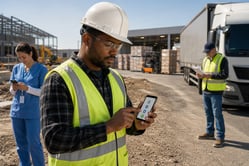
From a phone, a tablet or a computer, employees can take a course at whatever moment fits their reality. No more waiting for the whole crew to be available in the same room.
For frontline workers, that flexibility makes all the difference.
Training moves closer to daily work and to the situations crews actually face on site.
And when it comes to safety, compliance or work quality, having the right information at the right moment can matter far more than checking a box in a training program.
Train better without slowing down operations
Digitizing training doesn't mean dropping a PowerPoint deck onto a phone.
The goal is to make learning simpler, more relevant and easier to fit into the day.
Short, accessible content built around field realities lets employees move at their own pace and revisit what they need.
With a solution like BRIX, companies can centralize their training and make it available directly to frontline teams in the same place as the tools they already use to stay informed and connected.
Training stops being a one-off event. It becomes a resource available whenever employees need it.
Building skills, and building people
Continuous training isn't only there to improve company performance.
It also sends employees a clear message:
We want to give you the tools to grow.
When an organization invests in skills development for its teams, it creates real paths for professional growth.
An employee can build new expertise, take on more responsibility, prepare for a supervisory role or simply become more autonomous in their work.
That progression can also have a positive effect on engagement and retention. Employees who see opportunities to learn and grow inside their company have more reason to picture a long-term future there.
Training that's accessible to everyone
The best training isn't necessarily the longest or the most elaborate.
It's the training employees can actually take, understand and apply.
By making training available right in the field, companies let more people build their skills, whatever their schedule or location.
They can also better identify the employees who want to learn more, grow and take on new responsibilities.
In the end, continuous training becomes more than a skills-development tool.

Comment augmenter l'adoption des applications de formation terrain en 2027
Pourquoi les applications de formation terrain restent-elles sous-utilisées ? Les équipes terrain n'ont pas le luxe d'un bureau, d'une connexion.


Qu'est-ce qui empêche les travailleurs terrain d'utiliser les applications de formation ?
Qu'est-ce qui empêche les travailleurs terrain d'utiliser les applications de formation ? Accès, temps, pertinence : les trois freins qui tiennent.

7 échecs de plateformes terrain dans les entreprises industrielles
7 raisons pour lesquelles les plateformes terrain échouent à grande échelle 80 % de la main-d'œuvre mondiale travaille sur le terrain, souvent sans.


